
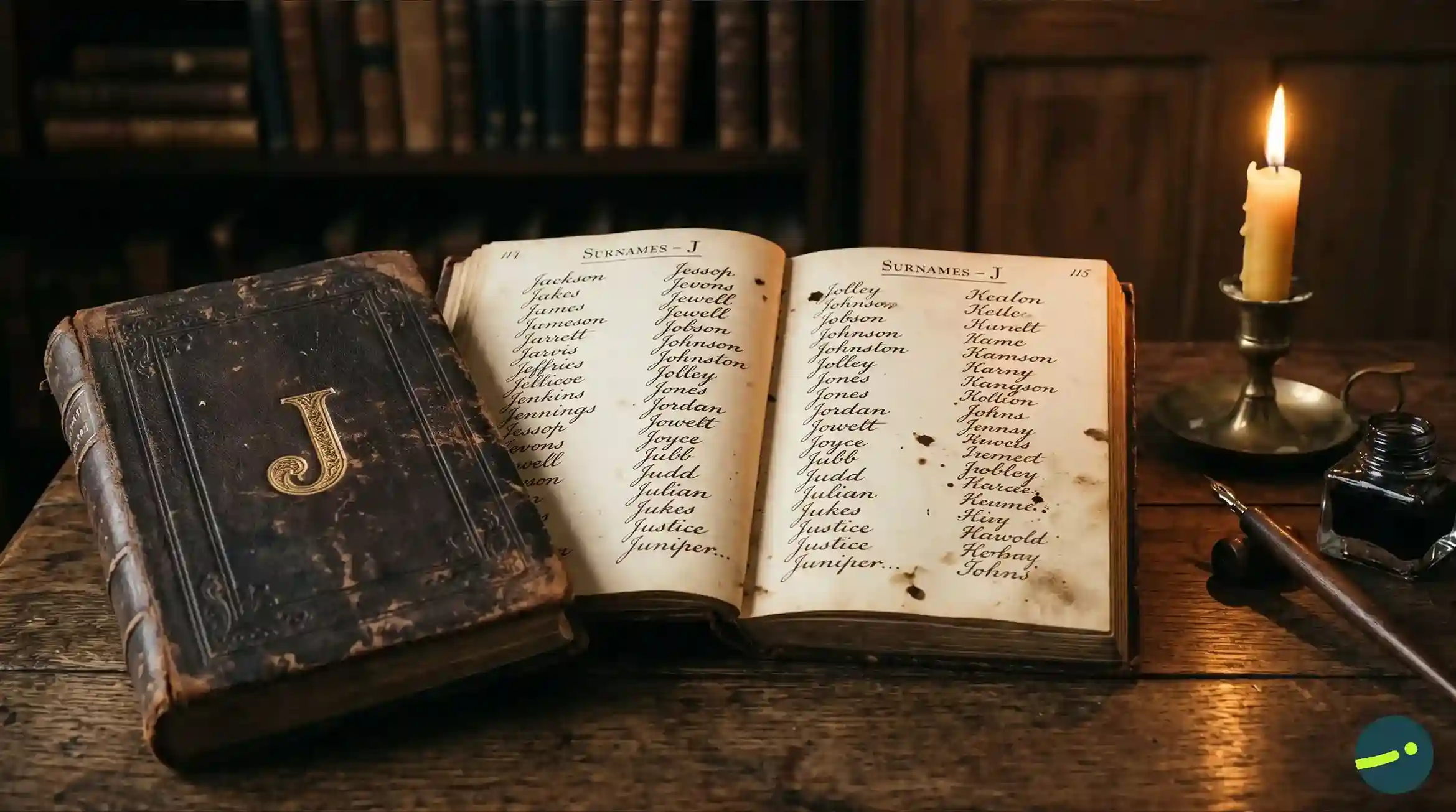
Last Names Starting with J: 200 Surnames with Meanings, Origins & Stories
Think about how many last names you know that start with J.
Johnson. Jones. Jackson. You probably hit those three inside two seconds.
Now try to name ten more. That is where it gets interesting.
J surnames stretch from ancient Hebrew roots to Norman French castles to West African naming traditions. Some carry the weight of US presidents. Others belong to jazz legends and ragtime composers. A few are so rare that fewer than 200 people carry them worldwide.
This is a complete guide to last names starting with J — 200 surnames sorted by category, each with its meaning and origin. Whether you are researching your family tree, naming a character, or just genuinely curious, there is a lot more here than Johnson.
Explore more surnames on BestLastNames for deeper dives into cultural naming traditions from around the world.
Why So Many J Surnames Come from One Source
Here is something worth knowing before the lists start.
A large share of English J surnames trace back to a single name: John.
John came from the Latin Johannes, which came from the Hebrew Yohanan, meaning “God is gracious.” It became one of the most common given names in medieval Europe — carried by apostles, kings, and popes. When people started adopting hereditary surnames in the 12th and 13th centuries, the sons of men named John needed a way to identify themselves.
The result was an explosion of variants. Johnson. Jones. Johnston. Jonson. Jensen. Johansson. Janssen. All of them, in different languages, mean the same thing: son of John.
According to the US Census Bureau’s 2020 Names Data, Johnson and Jones both rank in the top five most common surnames in America — a position they have held since the very first census in 1790. That is over 230 years of dominance, rooted in a single medieval given name.
Not all J surnames follow this pattern. Plenty have nothing to do with John. But understanding this root helps explain why so many of the most familiar J surnames feel like variations on the same theme.
17 Most Common Last Names Starting with J in the United States
These are the J surnames you will encounter most often. Each one has earned its place through centuries of use.
| Name | Origin | Meaning |
|---|---|---|
| Johnson | Old English | Son of John. Second most common surname in the US — 2.1 million Americans. First recorded as Jonessone in Surrey, 1287. |
| Jones | Welsh/English | Son of John. The Welsh form of Johnson. Fifth most common surname in the US. |
| Jackson | Old English | Son of Jack (a medieval pet form of John). 19th most common in the US. |
| Jenkins | Welsh | From Jenkin, a Welsh diminutive of John. Medieval and widespread. |
| Jordan | Hebrew/Latin | From the River Jordan, meaning “to flow down.” Used by Crusaders who were baptised in its waters. |
| James | Hebrew | From Yaakov (Jacob), meaning “supplanter.” A surname that began as a first name. |
| Jefferson | Old English | Son of Jeffrey. Carries presidential weight since Thomas Jefferson. |
| Jensen | Danish/Norwegian | Son of Jens, the Scandinavian form of John. The most common surname in Denmark. |
| Jimenez | Spanish | Son of Jimeno, an old Spanish form of Simon. Very common in Hispanic communities across the US. |
| Johansson | Swedish | Son of Johan (John). Common across Scandinavia and among Swedish-American families. |
| Johnston | Scottish | From John’s town — a place name turned surname. Distinct from Johnson in geography and origin. |
| Juarez | Spanish | From a place name in Spain. Associated with Benito Juárez, Mexico’s first Indigenous president. |
| Jacobs | Hebrew | Son of Jacob. Jacob means “one who follows at the heel” or “supplanter.” |
| Jarrett | French/English | From the medieval name Gerard, meaning “strong spear.” Came through Norman influence. |
| Jimenez | Spanish | Son of Jimeno. Among the fastest-growing Hispanic surnames in the United States. |
| Jorgensen | Danish | Son of Jorgen — the Danish form of George, meaning “farmer.” |
| Joyce | Irish | From the Welsh Jodoc, meaning “lord.” Arrived in Ireland with a Norman family in the 13th century. |
Related Article: American Last Names: Origins, Trends & 137 Examples
23 J Surnames with the Best Meanings
Some surnames are grammatically plain. These are not.
These J surnames carry meanings worth knowing — meanings that say something real about the landscape, occupation, or personality of whoever first held them.
Jager — German for “hunter.” A surname given to those who hunted professionally for a lord or estate. Clean, direct, still used widely in Germany and South Africa.
Jolicoeur — French Canadian, meaning “pretty heart” or “cheerful heart.” Originated in France, spread through Quebec and Louisiana. Still found in Haiti, Mauritius, and Montreal today.
Jarvis — From the Norman Gervase, rooted in a Germanic element meaning “spear.” Arrived in England with the Norman Conquest of 1066.
Journey — Old French journée, meaning “a day’s work.” Originally an occupational surname for day laborers. The word “journeyman” shares the same root.
Jenner — From “engineer” in Middle English, referring to someone who operated siege machinery. One of the more underappreciated occupational surnames in English.
Joplin — From County Durham in northern England, possibly tied to a nickname meaning “the fool” (from German Jop). Scott Joplin and Janis Joplin made it famous independently on opposite ends of American music history.
Jewel — From the medieval given name Jewell, which itself derived from Joel (meaning “Jehovah is God” in Hebrew). Became a surname in the West Country of England.
Joslin — Norman French, from Joscelin, a Germanic name meaning “one of the Gauts (a Germanic tribe).” Brought to England in the 11th century.
Joiner — Middle English occupational surname for a skilled woodworker who made furniture using joinery — fitting pieces together without nails. Distinct from a carpenter.
Juniper — Possibly occupational (an herbalist who worked with juniper) or locational. One of the rarer English surnames with a botanical origin.
Jernigan — A variant of Jernegan, from a Norman family name. Found predominantly in the American South.
Jessen — Low German, meaning “son of Jens.” Common in northern Germany and Denmark.
Jett — French Judah variant, connected to the precious stone jet (the dark gemstone). Also used as an Anglicized version of Yetta.
Jobes — From the biblical name Job, meaning “the persecuted one” or “one who weeps.” Old English.
Judson — Son of Judd. And Judd was a medieval pet form of Jordan, meaning “flowing down” from the Hebrew Yarden.
Jolley — From Middle English joli, meaning “merry” or “lively.” A nickname surname that described personality before it described a family.
Jago — A Cornish variant of James. Common in Cornwall and found occasionally in Cornwall-descended families in Australia and New Zealand.
Jory — Cornish form of George, meaning “farmer.” Rare, regional, and distinctly Celtic.
Jessop — A variant of Joseph, through the Middle English Jossop. Joseph means “may God add” in Hebrew.
Jaramillo — Spanish, from a place in Burgos, Spain. Means “brushwood” or “scrubland.” Now very common in Mexican-American communities.
Jurado — Spanish, from the past participle of jurar (to swear). Originally given to someone who served as a juror or official witness in a legal context. An occupational surname in its truest sense.
Janvier — French for “January.” Given to those born in that month or possibly connected to a feast day. Still found in France and Quebec.
Jaubert — Occitan-French, from a Germanic personal name meaning “splendid pledge.” A medieval aristocratic name that became a regional surname in southern France.
31 Cool J Last Names for Characters, Pen Names & Writers
Writers search for J surnames for good reason.
J has a hard edge in English. It moves fast off the tongue. It works in full names — “Eva Jarvis,” “Cole Jett,” “Maren Joslin” — without crowding the first name.
These are surnames that work. Each one is real, documented, and carries something a little more interesting than the first names on this list.
| Name | Origin | Why It Works |
|---|---|---|
| Jarvis | Norman English | Military root, smooth sound — hero or villain |
| Jett | French/Hebrew | Short, dark, gemstone energy |
| Joslin | Norman French | Literary, old, quietly strong |
| Joplin | Northern English | Musical legacy without feeling like a tribute |
| Jago | Cornish | Celtic edge, barely known outside Cornwall |
| Jory | Cornish | Same family — rare and regional |
| Jessop | English | Old-fashioned in the best way |
| Jopling | Northern English | Unusual but pronounceable |
| Janeway | English | From Jan’s way — a path surname |
| Jolicoeur | French Canadian | Beautiful, melodic, unusual in English fiction |
| Jager | German | Hunter — does not need explaining |
| Janvrin | French | Rare Norman surname, old aristocratic feeling |
| Jenner | Middle English | Engineer origin — layered for a technical character |
| Jory | Cornish | One syllable, Celtic root |
| Judd | Medieval English | From Jordan, medieval and grounded |
| Jubilee | Hebrew/English | From yovel, a year of freedom |
| Jurado | Spanish | Legal origin — fits a morally complex character |
| Jago | Cornish | Could pass for fantasy, actually historical |
| Janvier | French | Month name — poetic and unusual |
| Jessen | Low German | Clean Scandinavian sound |
| Joubert | French | Aristocratic, flows well in French-adjacent settings |
| Jarman | Old English | “German” — given to ethnic outsiders in medieval England |
| Jaynes | English | A variant of John, with more edge |
| Jessamine | English/French | From the jasmine flower — botanical surname |
| Jinkins | Welsh variant | Rougher spelling of Jenkins — working-class feel |
| Jurgens | German/Dutch | Son of Jurgen (George). Sturdy, northern European |
| Jaubert | Occitan | For settings in medieval southern France |
| Joscelyne | Norman French | The original form of Joslin — female-leaning |
| Jollimore | French Canadian | Merry sea — a compound surname from Nova Scotia |
| Juniper | English botanical | A surname that sounds invented but is not |
| Judkins | Middle English | Diminutive of Judd — humble and English |
Related Article: 200 Cool Last Names: Badass, Unique & Meaningful
19 Rare J Last Names That Are Almost Extinct
These are real surnames. They are just being carried by fewer and fewer people.
Some of these may vanish within a generation. That is not dramatic. It is just how surnames work — families without sons, name changes, immigration anglicisations. The names below are documented and traceable. They are just rare.
Jollimore — Meaning “merry sea” in Old French. Concentrated almost entirely in Nova Scotia, Canada. A handful of families keep it alive.
Jolicoeur — “Pretty heart” in French. Common in 18th-century Quebec. Now rare even in Canada.
Jory — Cornish form of George. Found mainly in Cornwall and its diaspora in Australia and New Zealand.
Jago — Another Cornish variant of James. Below 500 bearers worldwide according to surname frequency data from Forebears.io.
Jopling — Northern English, from County Durham. The musician Michael Jopling (UK Arts Minister) and the gallery Jopling are its most visible modern connections.
Janvrin — A rare Norman surname. Found in small numbers in the Channel Islands.
Joscelyne — The original Norman spelling of Joslin. Occasionally appears in 19th-century English parish records.
Jaubert — Southern French, barely surviving outside the Occitanie region.
Jukes — A medieval English surname from Joce (a form of Joyce). Used by 19th-century researchers as a case study in heredity and social class — the “Jukes family” became a cautionary tale in early eugenics debates, which says more about those researchers than about the surname.
Jurden — An old variant of Jordan, found in scattered records in the West Midlands of England.
Joines — An Appalachian variant of Jones, found in North Carolina and Virginia family records from the 1700s onward.
Jenkin — The uninflected form of Jenkins, found in Welsh records before the patronymic -s became standard.
Jervoise — A rare variant of Jarvis, found in Hampshire, England. An old Hampshire family bore this name for centuries.
Jolliffe — From Old French joli (merry). Used in southern England. Distinct from Jolley in geography if not in root.
Jobes — From the biblical Job. Scattered throughout Pennsylvania and Ohio records from the 18th century.
Jephcott — An English surname possibly from Geoffrey’s cottage. Rare and found almost entirely in the West Midlands.
Jinkins — An older Welsh spelling variant. Gradually disappeared as Jenkins became standardised.
Jessamine — The botanical surname, from jasmine. Exceptionally rare — documented but barely living.
Judkins — A diminutive of Judd. Found in scattered records across southern England.
27 J Surnames from Other Cultures
J surnames are not just an English phenomenon.
Across languages, the letter J carries different sounds and entirely different traditions. In Spanish, it sounds like a hard H. In French, it is soft. In Japanese, names romanised with J carry meanings embedded in kanji characters that an English translation can only approximate.
Japanese J surnames:
| Name | Kanji meaning | Notes |
|---|---|---|
| Jinnai (陣内) | “Inside the camp” | Military origin, still in use |
| Jinji (神事) | “Divine affairs” | Rare, tied to Shinto tradition |
| Jikihara (直原) | “Honest meadow/field” | Possibly given to farmers |
| Jimbo (神保) | “Deity, treasure” | Also written as Jinbo |
| Jyumonji (十文字) | “Cross / crossroads” | Literally “ten-character cross” |
Spanish J surnames:
| Name | Origin | Meaning |
|---|---|---|
| Jimenez | Patronymic | Son of Jimeno (Simon) |
| Juarez | Place name | From a Spanish town |
| Jaramillo | Place name | “Brushwood” — common in Colombia and Mexico |
| Jurado | Occupational | “Sworn-in official / juror” |
| Jara | Botanical | “Cistus shrub” — a common shrub in Iberia |
German J surnames:
| Name | Origin | Meaning |
|---|---|---|
| Jager | Occupational | “Hunter” |
| Jahn | Patronymic | Son of Jan (John) |
| Jung | Descriptive | “Young” — given to the younger of two men with the same name |
| Junker | Status | “Young nobleman” — a landed gentry title |
| Jansen | Patronymic | Son of Jan — very common in the Netherlands and northwest Germany |
French J surnames:
| Name | Origin | Meaning |
|---|---|---|
| Janvier | Calendar | “January” |
| Joubert | Germanic | “Splendid pledge” |
| Jolicoeur | Nickname | “Pretty heart” |
| Jaubert | Germanic | Variant of Joubert |
| Jourdain | Place/river | French form of Jordan |
Irish J surnames:
| Name | Origin | Meaning |
|---|---|---|
| Joyce | Norman-Irish | From Welsh Jodoc, meaning “lord” |
| Jordan | Norman-Irish | Brought by Crusaders, adopted in Ireland after 1169 |
| Jennings | Norman | From Janin, a French diminutive of John |
29 J Surnames Sorted by Meaning Type
Sometimes people search for surnames by what they mean, not just how they sound.
Names meaning warrior or strength: Jarvis (spear), Jager (hunter), Jackson (son of Jack, from Old Norse meaning “God is gracious”), Junker (young nobleman)
Names tied to nature or place: Jordan (the river), Joyce (lord of land), Joiner (woodworker), Jara (shrub), Jaramillo (brushwood), Juniper (plant), Holt-Jansen (near the grove), Jessen (by the marsh)
Names meaning son of someone: Johnson, Jones, Jenkins, Jensen, Johansson, Jimenez, Jorgensen, Jacobs, Jefferson, Jennings, Johnston
Names from nicknames or personality: Jolley (merry), Jolicoeur (cheerful heart), Jollimore (merry sea), Jobes (the persecuted)
Names from occupations: Jenner (engineer), Joiner (woodworker), Jager (hunter), Jurado (juror), Jester (entertainer), Jewett (possibly goldsmith-adjacent, from Jewell)
Names tied to biblical roots: James (Jacob), Jacobs (Jacob), Joseph (may God add), Judson (Jordan), Jordan (river from scripture), Jeremiah (God will exalt)
A Note on How to Use This List
Every surname here is documented. None are invented.
That matters for two reasons. If you are researching family history, a name in this list is a real lead — something to look up in census records, immigration documents, or parish registers. If you are naming a character, a real surname with a traceable history adds weight that invented names rarely achieve.
For genealogy research, the US Census Bureau Surname Data offer frequency data and geographic distribution for virtually every surname on this list.
And if your surname is not here — if it starts with J and you cannot find it anywhere — that is often the most interesting sign of all. It might mean your family carried something rare enough to be worth chasing.
Wrap-Up
Last names starting with J cover more ground than most people expect.
They run from the Hebrew roots of John to the Cornish coast, from Norman French castles to Spanish colonial records, from medieval hunting estates to Jazz Age America. Johnson and Jones barely scratch the surface.
The J that begins them all is just a letter. What it starts is a history.
Browse more surname collections by culture, letter, and style at BestLastNames — including our guides to unique surnames and the most common last names by country.