100+ Ukrainian Last Names with Meanings, History & Rare Picks
A surname isn’t just a label. It’s a thread in your family’s story. Ukrainian last names carry centuries of heritage, shaped by trades, regions, and even revolutions. Wanna know where your name comes from or how to choose one that feels deeply Ukrainian? The answer often starts with one question: what does your name really mean?
Ukrainian last names are rich with symbolism. Many come from occupations; blacksmiths, shoemakers, millers. Others come from first names, places, or even personality traits. They often end in -enko, -chuk, -sky, or -vych, each telling its own story. These endings are like fingerprints; they reveal where your family once stood on the map, or what role they played in the village.
Let’s dive into 31 Ukrainian surnames presented by BLN, that hold powerful meanings:
31 Ukrainian Last Names With Meanings
| Last Name | Meaning |
| Shevchenko | Son of a shoemaker |
| Melnyk | Miller |
| Bondarenko | Descendant of a cooper (barrel maker) |
| Kovalenko | Son of a blacksmith |
| Boyko | Possibly from “boj” (fight) — a fighter |
| Kravchenko | Tailor’s son |
| Tkachenko | Weaver’s child |
| Kovalchuk | Son of a smith |
| Rudenko | Reddish hair or complexion |
| Savchenko | Son of Savka (a first name) |
| Zelensky | From “zeleny” – green; could be toponymic |
| Dmytrenko | Son of Dmytro |
| Ivanko | Little Ivan |
| Petrenko | Son of Petro |
| Yakovenko | Son of Yakiv |
| Lysenko | From “lysiy” – bald |
| Mazurenko | Of Mazur origin (possibly Polish roots) |
| Pavlenko | Son of Pavlo |
| Hrytsenko | From Hryts (Gregory) |
| Verbytskyi | From “verbа” – willow tree |
| Polischuk | Person from Polissia region |
| Biletskyi | From “bily” – white or fair |
| Moroz | Frost – used for someone cold or stoic |
| Honchar | Potter |
| Zadorozhny | From “za dorohoyu” – beyond the road |
| Tymoshenko | Child of Tymofiy |
| Lukashenko | From Luka (Luke) |
| Demchenko | Descendant of Demko |
| Kulyk | Curlew bird – nickname-based |
| Shvets | Shoemaker |
| Holub | Dove – soft or peaceful nature |
These names aren’t just popular. They’re anchors. As one Reddit user shared while tracing their lineage:
“I found out my great-grandfather was a Tkachenko. I never knew what it meant until I Googled it. Weaver. Suddenly it made sense, he worked in textiles his whole life.” (Reddit)
23 Fascinating Facts About Ukrainian Last Name History
Ukrainian last names didn’t just appear. They evolved, shaped by land, language, and empire. Each name is like a scar on an old oak tree: personal, historical, and proud.
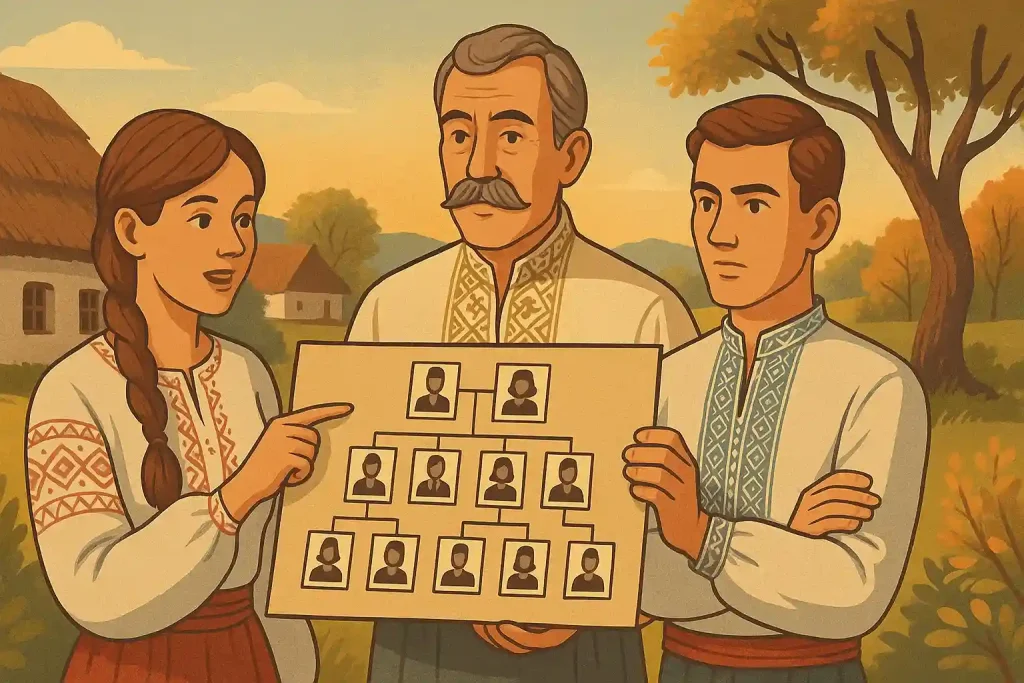
1. Surnames became official in the 1700s
Before then, most Ukrainians didn’t need last names. Villages were small. Everyone knew who you were. You were “Ivan, son of Petro.” That was enough, until governments needed records.
2. Nobility led the way
Aristocrats were among the first to adopt surnames, often borrowing from Polish or Latin traditions. Names like Skoropadskyi or Doroshenko signaled wealth or landownership.
3. The Church made them stick
In 1632, Metropolitan Petro Mohyla ordered surnames to be used in Orthodox Church documents. It was a move toward structure and control.
4. Austrian bureaucracy locked them in
When Western Ukraine came under Austrian rule in the late 1700s, surnames became essential for tax, property, and census purposes. If your family didn’t have one, officials gave you one.
5. Most surnames come from four sources
Ukrainian last names typically derive from:
- Occupations (e.g., Melnyk – miller)
- Patronymics (Ivanenko – son of Ivan)
- Locations (Polischuk – from Polissia)
- Nicknames or traits (Rudenko – red-haired)
6. Suffixes tell a story
The endings -enko, -chuk, -skyi, -vych are like maps. They reveal region, ancestry, and sometimes class. For example, -enko names often come from central Ukraine.
7. Names shifted with borders
Ukraine has been ruled by Poland, Russia, Austria, and more. Each power left its fingerprint on language and naming systems.
8. Russification changed spellings
Under Russian rule, Ukrainian names were often rewritten. Tkachenko became Tkachenko (no change), but Shumko might turn into Shumkov. A soft “-ko” became a hard “-ov.”
“My great-grandfather’s name was Shvets. But on his Soviet ID? Shvetsov,” a Reddit user shared. “It didn’t sound like us anymore.”
(Source: Reddit)
9. Gendered forms were lost in translation
In Ukraine, surnames can change with gender:
- Zelensky (male) → Zelenska (female)
- Bilyk (neutral) stays the same
This nuance is often dropped in English records.
10. Some surnames are poetic
Names like Holub (dove), Zirka (star), or Verbovyi (willow tree) echo folk traditions and nature, language shaped by the land.
11. Surnames acted as social markers
The richer your family, the more likely your name ended in -skyi or had Polish influence. Peasant names leaned toward jobs: Bondar (barrel maker), Kravets (tailor).
12. Jewish surnames followed different rules
While Ukrainian Christians often inherited surnames over generations, Jewish Ukrainians were sometimes forced to adopt names later, often based on towns (e.g., Brodsky) or qualities.
13. Ukrainian surnames resist neat categories
There’s overlap, fluidity, and contradictions. A name might be patronymic and occupational. Others evolved as borders moved or families migrated.
14. Soviet-era ID cards changed names again
During the USSR, internal passports often simplified, mistranslated, or “Russified” surnames to standardize them across republics.
15. Some names are shared across Slavic nations
A name like Koval (blacksmith) can appear in Ukraine, Poland (Kowal), and Russia (Kovalov)—but the roots remain distinct.
16. The surname “Boyko” caused debate
Some believe it comes from “boj” (fight), others say it refers to a Carpathian ethnic group. Either way, it’s deeply Ukrainian.
17. Many names end in “-ko” but not all
While -ko is often called the Ukrainian signature, it’s not exclusive. Surnames like Hnatyshyn or Zabolotny are just as Ukrainian.
18. Names traveled with immigrants
From Canada to Argentina, Ukrainian surnames were often shortened, respelled, or adapted. Melnyk might become Melnik, Bondarenko shortened to Bondar.
19. Online tools now trace their roots
Sites like ridni.org let users trace surname distribution across Ukraine using 2013 records.
20. Some names reveal humor or character
Names like Durak (fool), Pylypiv (talkative), or Zadokhlyi (wheezing) originated as nicknames. They stuck. They became my identity.
21. The diaspora brought new meaning
For Ukrainians abroad, names became more than ancestry. They became symbols of survival.
22. Names were passed without books
Before surnames were written down, they were spoken. Word of mouth passed them from parent to child.
23. Every name carries a story
Even the plainest name has a past. A field, a forge, a shoemaker’s bench, names are the fingerprints of history.
19 Common Ukrainian Last Names (And What They Really Mean)
Some last names whisper their meaning. Others shout it. In Ukraine, surnames often told neighbors exactly who you were not just by name, but by craft, origin, or lineage.
Most common Ukrainian last names come from two places: what your ancestors did, or who they were descended from. A surname was your business card before there were business cards.
Here are 19 of the most common Ukrainian last names — along with their meanings, and the stories they carry.
1. Melnyk
Meaning: Miller
Origin: Occupational
Millers fed the village. They were essential. Melnyk shows up across central and western Ukraine. It’s one of the most widespread surnames in the country.
2. Shevchenko
Meaning: Son of a shoemaker
Origin: Patronymic/Occupational
From shevets (shoemaker). A name passed from father to son. Also famously worn by poet Taras Shevchenko — a cultural icon and national voice.
3. Kovalenko
Meaning: Son of a blacksmith
Origin: Patronymic/Occupational
From koval (blacksmith) + ‑enko (son of). Found heavily in central Ukraine, especially around Cherkasy and Poltava.
4. Boyko
Meaning: Possibly from “boj” – fight or linked to Boyko ethnic group
Origin: Ethnic/Regional
The Boyko people are a distinct Carpathian group. This surname is both a name and a cultural fingerprint.
5. Tkachenko
Meaning: Son of a weaver
Origin: Occupational/Patronymic
Weaving wasn’t just a job. It was tradition. This surname reflects a family trade passed down for generations.
6. Kravchenko
Meaning: Son of a tailor
Origin: Occupational
From kravets (tailor). A name stitched into Ukrainian society. Still common in urban centers.
7. Kovalchuk
Meaning: Child of a blacksmith
Origin: Patronymic/Occupational
A regional variation of Kovalenko, often found in western Ukraine.
8. Bondarenko
Meaning: Descendant of a cooper (barrel maker)
Origin: Occupational/Patronymic
Every village had one. Barrels were life. And the name has stuck through centuries.
9. Rudenko
Meaning: Red-haired or ruddy complexion
Origin: Descriptive/Nickname
From Rudy (red). Likely described the first redhead in the family line.
10. Petrenko
Meaning: Son of Petro (Peter)
Origin: Patronymic
Classic –enko surname. Spread widely in east and central Ukraine.
11. Koval
Meaning: Blacksmith
Origin: Occupational
One of the oldest and simplest craft-based names. Shared across many Slavic languages.
12. Savchenko
Meaning: Son of Savka
Origin: Patronymic
From a common male first name. A name that feels deeply Slavic.
13. Shevchuk
Meaning: Shoemaker
Origin: Occupational
A cousin to Shevchenko. Still widespread in southern and central Ukraine.
14. Yakovenko
Meaning: Son of Yakiv (Jacob)
Origin: Patronymic
Strong religious roots. A common name in areas with deep Orthodox traditions.
15. Dmytrenko
Meaning: Son of Dmytro
Origin: Patronymic
Another staple of the –enko system. Still commonly found in family trees.
16. Moroz
Meaning: Frost
Origin: Descriptive
Used for someone born in winter — or maybe just tough as ice.
17. Honchar
Meaning: Potter
Origin: Occupational
Pottery was respected work. This name still carries that hands-in-clay feeling.
18. Polischuk
Meaning: Person from Polissia (northern Ukraine)
Origin: Regional
Your name told people where you came from. Polischuk means “swamp-dweller” from the lush northern woodlands.
19. Hrytsenko
Meaning: Son of Hryts (Gregory)
Origin: Patronymic
Another classic –enko name, still widespread in rural regions.
31 Cool Ukrainian Last Names for Modern Use
Some Ukrainian last names feel timeless. Others feel like they were made for today. Whether you’re naming a baby, a book character, or just want to wear your heritage with pride, these names strike that rare balance, modern yet rooted, sleek yet soulful.
These aren’t just old village names. They’re words that carry rhythm, character, and a whisper of the past.
A good name works like a compass, pointing you to who you are, or who you want to be. These Ukrainian last names can hold memory, mood, or even mystery. As one Reddit user said when choosing a name for their novel’s heroine:
| Last Name | Why It’s Cool |
| Bilyk | Crisp and clean; means “white” or fair |
| Zirka | Star — poetic and rare |
| Lemko | Ethnic name; short and strong |
| Holub | Dove — peaceful, soft |
| Moroz | Frost — edgy and bold |
| Shvets | Shoemaker — simple and craft-rooted |
| Zolotykh | From “gold” — unique and elegant |
| Kulyk | Curlew (bird) — great for a creative soul |
| Verba | Willow — nature-inspired |
| Bracha | Gentle and melodic |
| Hnatyshyn | Sounds powerful; political heritage too |
| Tarnovska | Noble roots; perfect for fiction |
| Danko | Friendly and warm tone |
| Vira | Faith — simple and meaningful |
| Lesko | Short and musical |
| Lazarenko | Has modern rhythm; deep roots |
| Babenko | Strong and confident sound |
| Radko | Feels fast and sharp |
| Havrylenko | Long but lyrical |
| Nalyvaiko | Rebellious — name of a 16th-century Cossack hero |
| Sydorenko | Has bounce and flow |
| Miroshnyk | Means “miller” — classic but stylish |
| Tkachuk | Compact and grounded |
| Zinchenko | Sporty appeal — like footballer Oleksandr Zinchenko |
| Dobry | Means “kind” — universal and upbeat |
| Lysenko | Famous in music and science — scholarly cool |
| Kovch | Ark — metaphorical and bold |
| Dovhan | “Tall” — perfect for standout characters |
| Savka | Warm and rooted in family |
| Chorna | “Black” — edgy and artistic |
| Solomiak | Rare and textural — great for fiction |
Clarifying 13 Misheard Ukrainian Last Names
| Heard/Seen As | Actual Explanation |
| Connon | Likely meant Common — not a Ukrainian surname |
| Zeichick | Possibly Yiddish/German; not widely recognized as Ukrainian |
| Zodar | No verified Ukrainian roots or suffix patterns |
| Zod | Unlikely Ukrainian; may be fictional or adapted |
| Jashenko | Probably meant Yashenko or Yashchenko |
| Balinskey | Polish influence; could be Balinskyi |
| Lazarevich | Real surname; Russian and Ukrainian roots |
| Shushkevich | Belarusian-Ukrainian crossover; real surname |
| Danchuk | Real — a patronymic meaning “child of Danylo” |
| Fedoriv | Legitimate; from Fedir (Theodore) |
| Tarnowsky | Polish-Ukrainian noble lineage; real |
| Zhivak | Rare but traceable; may be Ukrainian-Russian border |
| Karpenick | Likely meant Karpenko — a known Ukrainian surname |
21 Ukrainian Jewish Last Names and Their Deep Roots
Unlike traditional Ukrainian surnames built around occupations or parentage, many Jewish surnames in Ukraine are toponymic. They trace back to the names of towns, regions, or landscapes.
Toponymic Roots: Where Name Meets Place
These surnames tell you where a family once lived or fled from:
| Surname | Origin Location |
| Brodsky | From Brody (a Jewish hub in western Ukraine) |
| Lvov | From Lviv (historic Lwów, Galicia) |
| Volynsky | From Volyn (Volhynia region) |
| Zhytomyrsky | From Zhytomyr |
| Umansky | From Uman (a major Hasidic pilgrimage site) |
| Dubinsky | From Dubno |
| Polonsky | From Polonne |
| Prilutsky | From Pryluky |
| Rohatynsky | From Rohatyn |
| Zaslavsky | From Zaslav |
| Kremenetsky | From Kremenets |
| Tarnopolsky | From Ternopil |
| Baranovsky | From Baranivka |
These names weren’t just about land — they were lifelines. They kept a trace of origin when identities were stripped or scattered.
How Migration Shaped These Names
From the late 1700s to early 1900s, waves of Jewish Ukrainians left Eastern Europe due to pogroms, persecution, and shifting empires. Names adapted with each move:
- Lvov became Levine
- Zhytomyrsky became Zitomer
- Dubinsky became Dubin or Dobin
Some dropped suffixes, others translated their names, and many were altered at immigration ports.
Related Article: Jewish Last Names: 51 Powerful Picks & Their Deep Meanings
17 Ukrainian Surnames Starting With B, G, H, J, and Z
Ukrainian surnames aren’t just full of meaning. They’re also musical. Some start with hard, proud sounds. Others glide. And some… don’t exist at all.
Let’s explore 17 last names by letter, including pronunciation tips and some cultural backstory.
Starting With B
These names often feel solid, grounded in trade or region.
| Surname | Meaning |
| Bondarenko | Descendant of a cooper (barrel maker) |
| Boyko | Possibly from “boj” (fight) or an ethnic group |
| Biletskyi | Possibly “white-colored” or fair |
| Babenko | Diminutive or patronymic from “Baba” or “Bav” |
| Bracha | Possibly derived from “brother” in Slavic |
Pronunciation Tip: “B” is soft in Ukrainian. Babenko sounds like BAH-ben-ko.
Starting With G
In Ukrainian, “G” is pronounced like a deep “H” — as in “Hutsul” or “Holub.” It differs from Russian where “G” is hard.
| Surname | Meaning |
| Gavrilchuk | Son of Havrylo (Gabriel) |
| Glushenko | From glukhyi – quiet or withdrawn |
| Gudzyak | Possibly from a dialect word for “lock of hair” |
Pronunciation Tip: Often written as “H” in English transliteration. Gavrilchuk = HA-vreeel-chook.
Starting With H
Unique to Ukrainian, the letter Г (He) is pronounced as a softer, breathier “H,” not a hard “G.”
| Surname | Meaning |
| Hrytsenko | Son of Hryts (Gregory) |
| Holub | Dove — symbol of peace |
| Hnatyshyn | From Hnat (Ignatius) |
| Humenyuk | Could relate to a worker (humen) |
Note: Many Ukrainian names that start with “H” are spelled with “G” in Russian — leading to confusion in records.
Starting With J
J does not exist in the Ukrainian alphabet. In Cyrillic, the closest equivalents are:
- Й = Y (as in Yuriy)
- Ж = Zh (as in Zhukov)
So surnames starting with “J” are usually transliterations or mishearings, like:
- Jashenko → likely Yashchenko
- Janiv → probably Yaniv (a town)
Bottom line: Real Ukrainian surnames don’t start with “J.” It’s an English artifact.
Starting With Z
Z-surnames are bold and full of edge. Many have toponymic or occupational roots.
| Surname | Meaning |
| Zolotar | Goldsmith |
| Zadorozhny | “Beyond the road” |
| Zelensky | From “zeleny” – green |
| Zolotykh | From “zoloto” – gold |
| Zinchenko | Son of Zinoviy |
Pronunciation Tip: “Z” is sharp and clean in Ukrainian. Zolotar = ZO-lo-tar.
15 Short Ukrainian and Russian Last Names to Know
Some names don’t need many syllables to carry weight. Ukrainian and Russian surnames often say a lot in just a few sounds. These short names are sharp, clear, and packed with history.
Shared Roots, Subtle Differences
While Ukraine and Russia share many Slavic roots, pronunciation and spelling often vary.
- Ukrainian: softer, breathier (e.g., Honchar)
- Russian: harder, more guttural (e.g., Goncharov)
15 Short Ukrainian or Russian Last Names with Big Meaning
| Surname | Origin | Meaning |
| Koval | Ukrainian/Russian | Blacksmith |
| Moroz | Ukrainian/Russian | Frost |
| Bilyk | Ukrainian | White or fair-skinned |
| Honchar | Ukrainian | Potter (Russian: Gonchar) |
| Kruk | Shared Slavic | Crow (symbol of wit or watchfulness) |
| Vovk | Ukrainian | Wolf — fierce, independent |
| Zima | Russian/Ukrainian | Winter |
| Rybak | Shared Slavic | Fisherman |
| Lev | Russian/Ukrainian | Lion |
| Dub | Ukrainian | Oak (strong, steady) |
| Lis | Shared Slavic | Fox (cleverness) |
| Bach | Ukrainian (Western regions) | Possible Jewish variant; rare |
| Shvets | Ukrainian | Shoemaker |
| Duda | Ukrainian/Polish | Bagpipe — possibly nickname-based |
| Zhuk | Ukrainian/Russian | Beetle — a nickname surname |
These names were often carved onto house signs or whispered through fields. They spoke of work, nature, or strength, in just one or two syllables.
“My grandfather’s name was Vovk,” one Reddit user shared. “We thought it was just a name. Then we found out it meant ‘wolf.’ Suddenly, it made sense , he was the lone wolf in our family.”
Short doesn’t mean simple. These names are old, sturdy, and still standing.
Wrap Up
Ukrainian last names carry deep meaning. They reveal heritage, region, and identity. Whether short or poetic, each name tells a story. Use the tools, learn the roots, and keep the legacy alive. Your surname matters. Wear it with pride.