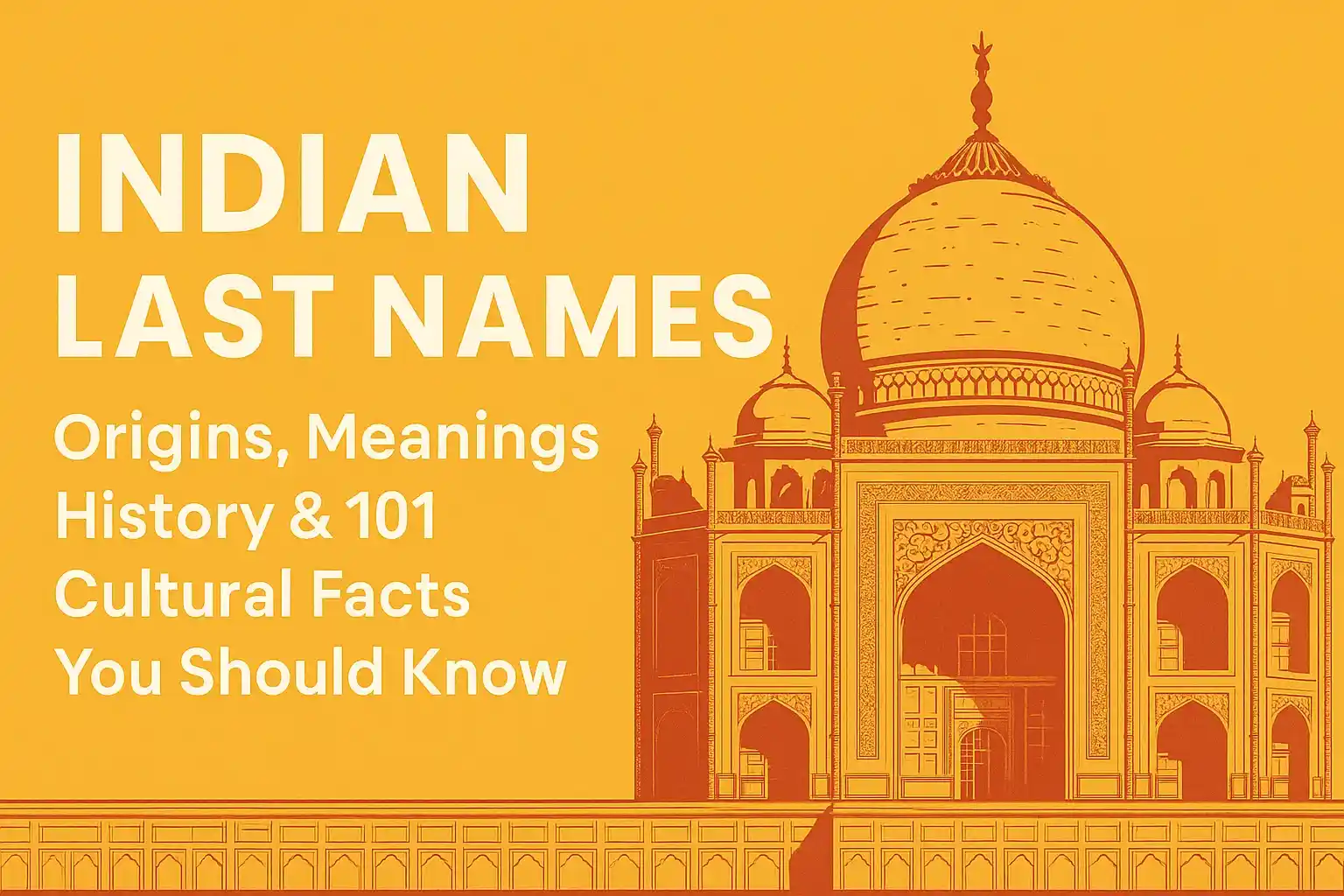
Indian Last Names: Origins, Meanings, History & 101 Cultural Facts You Should Know
Indian last names represent caste, culture, community, religion and sometimes contradiction. Millions are searching for “Indian last names” to understand their roots, choose a name for their child, or make sense of forms that force a first and last name format.
If you are one of them, this guide is for you. You’ll find more than definitions and last names suggestions at BLN.
What Are Indian Last Names? (Explained Simply)
An Indian last name tells people who you were, where you came from, and often what you did for a living.
Understanding Indian last names starts with unlearning the idea that all names follow the same rules. In India, they rarely do.
31 Most Common Indian Last Names (With Region-Wise Rankings)
When it comes to common Indian last names, many names are statistically popular in India. Some, like Singh, were once exclusive to warrior clans and later adopted by millions as a symbol of equality. Others, like Devi, are honorifics that became inherited surnames through sheer usage. As listed by Wikipedia, common last names like Ram (~7 M), Kumari (~6.6 M), and Lal (~5.7 M) also feature prominently Here’s a breakdown of the most common Indian last names, along with where they dominate geographically:
| Rank | Last Name | Estimated Bearers | Meaning / Origin | Region |
| 1 | Devi | ~70 million | Goddess | East, especially Bihar, West Bengal |
| 2 | Singh | ~35 million | Lion (Rajput/Sikh title) | North: Punjab, UP, Bihar |
| 3 | Kumar | ~31 million | Prince / Youth | Pan-India |
| 4 | Das | ~11 million | Servant (religious) | East: Bengal, Odisha |
| 5 | Kaur | ~9.5 million | Princess / Female Sikh title | Punjab, Sikh diaspora |
| 6 | Yadav | ~8 million | Pastoral caste | North: UP, Bihar, Haryana |
| 7 | Sharma | ~7 million | Brahmin / Joyful | North: Delhi, Rajasthan, MP |
| 8 | Patel | ~6 million | Village Headman | West: Gujarat, Maharashtra |
| 9 | Reddy | ~5 million | Landowning caste | South: Andhra, Telangana |
| 10 | Verma | ~4.8 million | Shielded / Noble | Central/North India |
| 11 | Naidu | ~4 million | Chief / Community head | South: Andhra Pradesh |
| 12 | Mehta | ~3.5 million | Accountant / Clerk | Gujarat, Rajasthan |
| 13 | Chowdhury | ~3.4 million | Landlord title | East: Bengal, Assam |
| 14 | Jain | ~3.2 million | Religion-based | Gujarat, MP, Rajasthan |
| 15 | Mandal | ~3 million | Landholder title | East: Bihar, Bengal |
| 16 | Ghosh | ~2.8 million | Cowherd / Kayastha clan | Bengal |
| 17 | Shah | ~2.7 million | Merchant / Banker | Gujarat, Maharashtra |
| 18 | Bhat | ~2.5 million | Scholar / Priest | Kashmir, Karnataka |
| 19 | Nair | ~2.4 million | Warrior caste | Kerala |
| 20 | Shetty | ~2.2 million | Business caste | Karnataka, Coastal West |
| 21 | Gupta | ~2 million | Protected / Trader | Bihar, UP, Bengal |
| 22 | Tripathi | ~1.9 million | Brahmin surname | UP, MP |
| 23 | Agarwal | ~1.8 million | Traders from Agroha | North & West |
| 24 | Pandey | ~1.7 million | Brahmin / Teacher | UP, Bihar |
| 25 | Joshi | ~1.6 million | Astrologer / Priest | Maharashtra, Gujarat |
| 26 | Sinha | ~1.5 million | Derived from Singh | Bihar, Jharkhand |
| 27 | Iqbal | ~1.4 million | Muslim poetic name | North India, Pakistan |
| 28 | Syed | ~1.3 million | Prophet’s descendant | Muslim regions |
| 29 | Begum | ~1.2 million | Muslim title (women) | East, Bangladesh border |
| 30 | Ali | ~1.1 million | Noble / Muslim surname | Pan-North India |
| 31 | Chavan | ~1 million | Maratha warrior surname | Maharashtra |
These popular Indian last names reveal how naming in India is stitched into caste, geography, migration, and reform. Our article on Asian Last Names With Rich History further explores pan-Asian patterns and shared surname traditions, such as Singh, Kumar, and Patel
23 Indian Last Names by Caste, Class, and Community
The Indian caste system, though legally abolished, still breathes through surnames like Sharma, Yadav, or Reddy. It’s not just who you are; it’s who your ancestors were, and what roles they played.

Here are 23 caste-linked Indian last names and what they represent:
| Last Name | Caste/Community | Meaning / Role |
| Sharma | Brahmin | Scholar, priest, spiritual leader |
| Pandey | Brahmin (Awadhi/Maithil) | Ritual expert, teacher |
| Bhattacharya | Bengali Brahmin | Head scholar or pundit |
| Tripathi | Brahmin | Scholar from three Vedas |
| Tiwari | Brahmin | Ritual officiator |
| Yadav | OBC (Ahir community) | Cattle-herders, Krishna lineage |
| Kurmi | OBC | Farmers, tillers |
| Reddy | Kamma/Reddiar (OC/OBC) | Landowners, warrior-farmers |
| Naidu | Kapu / Balija (OBC) | Village administrator |
| Gowda | Vokkaliga (OBC/OC) | Farmer community head |
| Verma | SC/OBC/Brahmin (varied) | “Armored,” often upward mobility name |
| Patel | Patidar (OC) | Village headman, tax collector |
| Mehta | Vaishya / Bania | Accountant, finance role |
| Agarwal | Vaishya | Merchant, trading class |
| Jain | Jain religion, Vaishya | Non-violent merchant community |
| Shetty | Bunt / Tuluva | Feudal landlords, businessmen |
| Deshmukh | Maratha (Kshatriya) | Provincial head |
| Chavan | Maratha | Warrior clan |
| Singh | Rajput/Sikh/Kshatriya | Lion / Warrior |
| Thakur | Rajput / Landed caste | Landlord, warrior class |
| Mandal | SC/OBC (Eastern India) | Village administrator |
| Das | SC/Brahmin/OBC (varies) | “Servant of God,” religious title |
| Koli | SC/OBC | Fisherfolk / Coastal caste |
Understanding the India caste system last names is about how identity and mobility have danced through generations.
19 Indian Last Names by Religion & Language
Religion shapes identity, but language stitches the local nuance. That’s what makes last names in India so layered.
Hindu Surnames
| Last Name | Region | Caste/Meaning |
| Sharma | North | Brahmin, joyful/protector |
| Iyer / Iyengar | Tamil Nadu | Brahmin sects (Smarta/Vaishnavite) |
| Banerjee / Mukherjee | Bengal | Bengali Brahmins |
| Reddy | Andhra/Telangana | Land-owning warrior class |
| Joshi | West India | Astrologer/priest |
Sikh Surnames
| Last Name | Region | Meaning |
| Singh | Punjab | “Lion” (male) |
| Kaur | Punjab | “Princess” (female) |
| Ahluwalia | Punjab | From village of Ahlu |
| Sandhu / Gill | Punjab | Jat clans |
Sikh surnames often eliminate caste. After Guru Gobind Singh’s reform in 1699, Singh and Kaur became universal names. These surnames are more powerful, equalizing titles rather than family chains.
Muslim Surnames
| Last Name | Region | Origin |
| Khan | Pan-India | Turkic/Mongol origin, “ruler” |
| Ali | North India | Descendant of Imam Ali |
| Ansari | UP, Bihar | Prophet’s tribe |
| Syed | Pan-India | Descendants of the Prophet |
| Farooqi | Urdu regions | Caliph Umar’s lineage |
Many Muslim surnames reflect Arabic or Persian honorifics. They signal religious lineage instead of geography.
Christian Surnames
| Last Name | Region | Influence |
| D’Souza | Goa/Kerala | Portuguese |
| Pereira | Goa | Portuguese |
| Thomas | Kerala | Biblical, Syrian Christian |
| Fernandes | Mumbai, Goa | Portuguese |
After colonialism and missionary work, many Christians adopted or were assigned European surnames. These names today blend seamlessly with Indian first names. It gave birth to a legacy of language, law, and faith.
Linguistic Influence in Last Names
- Tamil: Subramanian, Pillai, Sundararajan
- Telugu: Kandukuri, Naidu, Rao
- Marathi: Deshmukh, Kulkarni, Chavan
- Bengali: Ghosh, Sen, Datta
- Sindhi: Advani, Talreja, Makhija (often end in -ani)
27 Regional Indian Last Names from North, South, East, and West
India have dozens of naming systems. Your last name in India can depend entirely on which state you’re born in, what language you speak, or how your grandparents filled out a form in 1965.
In the North, surnames often reflect caste or clan. In the East, they can be titles or community markers. In the West, they blend occupation with geography. But in the South? The rules flip. Last names are often not surnames at all, they’re father’s names, initials, or village names that aren’t even passed down.
Let’s break it down by region:
Regional Last Name Map
| Region | Last Names | Notes |
| North India | Sharma, Singh, Yadav, Tripathi, Verma, Pandey | Caste-linked; many follow First + Last format |
| South India | Reddy, Naidu, Aiyer, Subramanian, Pillai | Patronymic; initials used instead of surnames |
| East India | Banerjee, Das, Ghosh, Chatterjee, Mandal | Brahmin or Kayastha surnames; sometimes toponymic |
| West India | Patel, Shah, Mehta, Deshmukh, Chavan, Shetty | Often linked to occupation or regional feudal roles |
Special Case: Tamil Nadu and Patronymic Initials
In Tamil Nadu, the surname isn’t a family name, it’s your father’s first name. Ramesh, son of Gopal, might be written as G. Ramesh. That “G” isn’t a last name. It’s a living, changing link to your parent.
The tradition stems from anti-caste reforms in the 20th century that intentionally broke with rigid family name systems. Instead of hierarchy, Tamil naming celebrates lineage, locality, and individual identity.And that’s the beauty of South Indian last names. È
29 Indian Last Names and Their Meanings (With Cultural Backstories)
Some Indian last names come from Sanskrit scriptures, while others from Persian r Arabic backgrounds.
Take Singh. It means “lion”. Once reserved for Rajput warriors, later universalized by Sikhs to erase caste. Or Kumari, which means “princess”, graceful, soft. It was used as a respectful suffix for unmarried women in many regions.
Below are 29 Indian last names and their meanings, including their cultural and linguistic roots:
| Last Name | Meaning | Origin / Language | Backstory |
| Singh | Lion | Sanskrit | Rajput and Sikh symbol of bravery |
| Kaur | Princess | Sanskrit | Feminine counter to Singh in Sikhism |
| Das | Servant of God | Sanskrit | Used by both Brahmins and SC groups |
| Kumar | Prince / Boy | Sanskrit | Used as middle or last name pan-India |
| Patel | Village Headman | Gujarati | Title of authority in land administration |
| Sharma | Joyful / Shelter | Sanskrit | Priesthood lineage in North India |
| Verma | Protected / Armored | Sanskrit | Adopted across castes for status elevation |
| Yadav | Descendant of Yadu (Krishna’s lineage) | Sanskrit | Ahir community claim Kshatriya roots |
| Naidu | Chief / Leader | Telugu | Common among Kapus in Andhra |
| Mehta | Chief Clerk | Persian | Used by business castes like Bania |
| Sheikh | Elder / Leader | Arabic | Islamic religious and scholarly lineage |
| Ali | Elevated / High | Arabic | Name of Prophet Muhammad’s cousin |
| Farooqi | Descendant of Umar | Arabic | Sunni Islamic surname in North India |
| D’Souza | Of Souza (Portuguese town) | Latin | Goan Christians under Portuguese rule |
| Pereira | Pear tree | Portuguese | Colonial surname for Indian Christians |
| Subramanian | Lord Murugan | Tamil-Sanskrit | Devotion-based Brahmin surname |
| Pillai | Prince / Junior | Tamil | Used by Nair and Pillai caste |
| Iyengar | Vedic scholar | Tamil | Vaishnavite Brahmin sect |
| Banerjee | Teacher / Pandit | Bengali | One of the “five Brahmin surnames” (Pancha-Jana) |
| Chatterjee | Minister / Scholar | Bengali | Derived from “Chattopadhyaya” |
| Mukherjee | Religious Teacher | Bengali | Lineage-based Brahmin title |
| Chavan | Young Warrior | Marathi | Maratha surname with military roots |
| Deshmukh | District Chief | Marathi | Feudal title from Maratha era |
| Shah | King / Banker | Persian | Common among Gujaratis |
| Ghosh | Cowherd | Bengali | Kayastha community |
| Tiwari | Learned one | Sanskrit | Common Brahmin surname in North India |
| Joshi | Astrologer | Sanskrit | Priestly class in West India |
| Agarwal | People of Agroha | Sanskrit | Merchant community; Bania lineage |
| Gupta | Protected / Secret | Sanskrit | Vaishya surname, sometimes Brahmin |
25 Indian American Last Names (And How They Change in the Diaspora)
In America, a form asks: First Name. Last Name. For many Indian immigrants, that’s where the trouble starts. What if your “last name” is actually your dad’s first name? Or your caste title? Or nothing at all?
So, Indian Americans adapt. They reshape surnames to fit into systems that weren’t built for them. Some simplify. Some fuse. Some invent a new name altogether.
Here are 25 Indian American last names as real examples of how they evolve, adjust, and stay rooted despite borders:
| Original Name | Adapted Form | Reason for Change |
| Ramasamy Krishnan | R.Krishnan | Shortened to fit U.S. forms |
| Aiyyer | Iyer | Phonetic simplification |
| Subramaniam | Subra | Informal shortening |
| Srinivasan | S. Vasan | Dropping prefixes |
| Gopalakrishnan | G. Krishnan | Using initials for brevity |
| Reddy Naidu | Reddy | Dropping compound structure |
| Chandrasekhar | Sekhar | Common truncation |
| Bhattacharya | Bhatt | Simplified spelling |
| Venkatesan | Venkat | Nickname used as surname |
| Kandukuri | Kandi | Shortened for ease |
| Satyavolu | Satya | Easier pronunciation |
| Chidambaram | Chidam | Adapted for passport fields |
| Parthasarathy | Parth | Split across first/last |
| Kumaran Iyer | Kumaran-Iyer | Hyphenated in diaspora |
| Lakshminarayanan | Laxmi | Cultural and digital ease |
| Sundeep Gupta | Sundeep | Dropped last name for privacy |
| Rajiv Verma | Raj Verma | Anglicized first name |
| Devansh Shah | D. Shah | Used initial to reduce name length |
| Naveen Kumar | N. Kumar | Shortened middle name |
| Priya Gopal | Gopal | Reversed first/last order |
| Anjali Mehta | Mehta | Retained for brand consistency |
| Sriram Ranganathan | Sriram R. | Used abbreviated last name |
| Arunachalam | Arun | Shortened for daily use |
| Ramamoorthy | Ram M. | Split to meet Western naming norms |
| Balamurugan | B. Murugan | Formatted to fit US ID systems |
Others hyphenate to retain identity as in Ravi-Subramanian and Kumari-Das. Some split it up. Some merge it down.That’s the truth of Indian American last names: they evolve in translation, but carry home with them.
17 Unique, Long, and Funny Indian Last Names (You’ve Probably Heard)
Some Indian last names are long. Some are hard to pronounce. And some? They’re just plain unforgettable.
Take Sodabottleopenerwala. Yes, that’s a real surname. It means exactly what it says: a person whose family once opened soda bottles. It’s Parsi. It’s occupational. And it’s glorious.
India has a long tradition of turning professions, objects, and even habits into surnames. Here’s a fun look at 17 long, funny, and truly unique Indian last names:
| Last Name | Meaning / Origin | Notes |
| Sodabottleopenerwala | One who opens soda bottles | Iconic Parsi name, now a restaurant chain |
| Batliwala | Bottle-seller | Common in Parsi and Gujarati communities |
| Daruwala | Liquor seller | “Daru” = alcohol in Hindi |
| Contractor | Yes, it’s a surname | Popular among Parsis |
| Engineer | Not a title, a surname | Also Parsi, passed down |
| Driver | Literally “chauffeur” | Anglo-Indian & Parsi families |
| Sutar | Carpenter | Common in Gujarat and Maharashtra |
| Lakhani | “Son of Lakh” (number) | Sindhi origin |
| Talreja | From Talra village | Sindhi suffix “-ja” means “descendant of” |
| Suleimanji | Respectful twist on Suleiman | “Ji” added for honor |
| Punekar | From Pune | Regional identity as last name |
| Kolhapure | From Kolhapur | Common in Maharashtra |
| Mundapalli | Village-linked Telugu surname | Long and locational |
| Chidambaram | City-based Tamil name | A mouthful on forms |
| Lakshminarayanan | Devotional compound name | Often shortened in diaspora |
| Venugopalakrishnan | Multiple deities in one name | Tamil Nadu special |
| Ramanujam | Famed mathematician’s name | Still common in Tamil Nadu |
So the next time someone asks about long Indian last names or laughs at one, remind them: behind every syllable is a story worth telling.
21 Naming Customs in India (First Name vs Last Name Traditions)
In India, your last name might not be your family name. It might be your father’s name, your village, your caste title or simply an initial. So when a visa form demands “First Name” and “Last Name,” millions of Indians just guess.
That’s because first name and last name in India don’t follow one rule. They follow a hundred.
Common Naming Formats Across India:
| Region | Format | Example |
| Tamil Nadu | Initial + Given Name | S. Ramesh (S = Suresh, his father) |
| Telangana/Andhra | Family + Given + Caste | Kandukuri Sriram Naidu |
| Kerala | House Name + Father + Self | Menon Narayanan Rajesh |
| North India | Given + Surname | Ankit Sharma |
| West India | Given + Community/Clan | Rahul Mehta |
| Bengal | Given + Caste Title | Arindam Chatterjee |
In many South Indian states, there’s no family name tradition. Instead, initials or father’s names get used. Until a school, passport form, or airline ticket demands otherwise.
Modern Changes & Common Workarounds:
- Many use father’s name as a last name on legal documents abroad.
- Some adopt their village name to create a fixed surname.
- Hyphenation is rising: Kumar-Reddy, Subra-Nair.
- Others create “international” versions of their names for being shortened, reordered, or Westernized.
Tips for Form-Filling Abroad:
- Choose one standard format and stick to it. Because consistency across IDs is key.
- If you use initials (e.g., R. Balaji), expand them when required.
- Avoid using caste or community names if uncomfortable, use middle names instead.
- For passports, make sure both Given Name and Surname fields are filled.
- Keep a note on official translations or alternate spellings used in education/employment records.
15 Famous Indian Last Names in Pop Culture, Film & Politics
Some Indian last names are just iconic. They’ve outgrown households and become empires, headlines, and hashtags. Think Ambani. That name isn’t just about wealth, but it’s shorthand for power. Or Bachchan, once just Amitabh’s family name, now synonymous with Indian cinema itself.
Here are 15 famous Indian last names that shaped pop culture, politics, and public imagination:
| Last Name | Known For | Legacy |
| Ambani | Business | Mukesh & Anil Ambani, Reliance Industries |
| Tata | Business | Ratan Tata, Tata Group—synonymous with philanthropy and ethics |
| Bachchan | Cinema | Amitabh, Abhishek, Aishwarya Rai Bachchan—Bollywood royalty |
| Khan | Cinema | Shah Rukh, Salman, Aamir—redefined Hindi film in the 90s-2000s |
| Kapoor | Cinema | Raj, Rishi, Kareena, Ranbir—India’s first true film dynasty |
| Gandhi | Politics | Indira, Rajiv, Sonia, Rahul—India’s most polarizing surname |
| Modi | Politics | Narendra Modi—Prime Minister, global face of modern India |
| Bhatt | Cinema | Mahesh, Alia, Pooja—mix of indie films and commercial hits |
| Chopra | Cinema / Music | Priyanka Chopra—Hollywood crossover, global appeal |
| Mukherjee | Cinema | Rani Mukherjee—Bengali film powerhouse |
| Deol | Cinema | Dharmendra, Sunny, Bobby—Punjab’s action legacy |
| Reddy | Politics | Y.S. Rajasekhara Reddy, Andhra Pradesh’s influential leader |
| Scindia | Politics | Royal lineage meets modern governance—Jyotiraditya Scindia |
| Mehta | Arts / Finance | Zubin Mehta (conductor), Harshad Mehta (stock market) |
| Banerjee | Politics / Literature | Mamata Banerjee, Jhumpa Lahiri (née Banerjee)—diverse domains |
11 Surprising Facts About Indian Last Names and Caste
Here are 11 surprising facts about how Indian last names and caste intertwine, evolve, and resist:
- Singh was once caste-bound. Originally a Rajput warrior title, Singh was universalized by Guru Gobind Singh in 1699 to flatten caste in Sikhism.
- Kaur means more than “princess.” It’s a declaration of equality for Sikh women, adopted as a middle or last name to replace caste-linked surnames.
- Some Brahmin surnames vary by region. Sharma in North India, Bhattacharya in Bengal, Iyengar in Tamil Nadu; same caste, different cultural stamp.
- Verma is a caste chameleon. Used across Brahmin, OBC, and SC communities, often adopted during social mobility efforts.
- Tamil Nadu challenged the caste-name link. As part of Dravidian anti-caste movements, many Tamils dropped surnames entirely or adopted initials.
- Many Dalit surnames were changed post-independence. Names like Mahar, Chamar were legally replaced with caste-neutral titles or first names.
- Naidu, Reddy, and Gowda are not castes, but communities. These South Indian surnames signal dominant rural groups with political weight.
- Some surnames were Sanskritized for prestige. OBCs and Dalits often adopted Brahminical names to escape caste-based stigma: a process known as Sanskritization.
- Gandhi is not a caste-linked name. Despite its legacy, Gandhi was adopted by Mohandas Karamchand Gandhi’s grandfather and isn’t linked to Brahmin or merchant identity.
- ‘Das’ is multi-caste. Used by Brahmins in Bengal, Vaishnav devotees in Odisha, and Dalits in Bihar; context matters.
- Jain surnames often hide in plain sight. Shah, Mehta, Golecha, Dugar; these reflect trade lineages, not priestly hierarchies.
Conclusion
Indian last names carry history, identity, and culture. They reflect caste, region, religion, and reform. From Singh to Patel, every surname tells a story. Naming in India is diverse as there is no one rule. Whether you’re tracing roots or choosing a name, understanding these patterns helps.