Top 100 Italian Last Names & Meanings That Tell a Story
Historically, Italian surnames fell into four buckets: names from parents (Di Stefano, “son of Stephen”), jobs (Ferrari, the blacksmith), geography (Romano, from Rome), or traits (Bianchi, “the white-haired”). Some even came from more painful stories—orphans named Esposito, meaning “exposed,” left anonymously at foundling homes.
But beyond structure, there’s soul. Below are 31 Italian last names with stories presented by BLN.
31 Stunning Italian Last Names and Their Meanings
| Last Name | Meaning / Origin |
| Rossi | “Red-haired”; most common surname in Italy. Often linked to Tuscany. Source |
| Russo | “Red”; more common in the south—Calabria, Sicily. Variant of Rossi. |
| Ferrari | “Blacksmith”; a nod to Italy’s working-class backbone and industrial roots. |
| Bianchi | “White-haired” or “fair”; also symbolizes purity. |
| Romano | “From Rome”; used across central Italy, and among the diaspora. |
| Marino | “Of the sea”; often from coastal towns like Naples or Genoa. |
| Esposito | “Exposed”; name given to foundlings, especially in Naples. |
| Vitale | “Life-giving” or “vital”; often used in southern Italy. A powerful, hopeful name. |
| Colombo | “Dove”; a name once used for orphans, like Esposito. Also tied to Christopher Columbus. |
| Greco | “Greek”indicates ancestry or contact with Greek communities, especially in Calabria. |
| De Luca | “Son of Luca”; classic patronymic name still widely used. |
| Fontana | “Fountain”; topographic surname from homes near springs. |
| Lombardi | “From Lombardy”; identifies northern Italian roots. |
| Gallo | “Rooster”; may refer to a proud or bold personality—or a heraldic symbol. |
| Conti | “Count”; noble surname, still found among aristocratic families. |
| Ricci | “Curly-haired”; often used as a nickname-turned-surname. |
| Amato | “Beloved”; a poetic name seen across southern Italy. |
| Pellegrini | “Pilgrim”; name given to travelers or religious wanderers. |
| Barbieri | “Barber”; a classic occupational surname. |
| Leone | “Lion”; symbolizes bravery or fierceness. |
| Bellini | “Little beautiful one”; affectionate and diminutive. |
| Testa | “Head”; sometimes a descriptive nickname for baldness or intelligence. |
| Mancini | “Left-handed”; culturally seen as unique or rare. |
| Ventura | “Luck” or “fate”; a surname brimming with optimism. |
| Romaniello | Diminutive of Romano; “Little Roman.” Common in Campania. |
| Caruso | “Boy” or “lad”; made famous by opera legend Enrico Caruso. |
| Napolitano | “From Naples”; indicates Neapolitan heritage. |
| Versace | Rare Calabrian surname; elevated by the fashion house. |
| Pagano | “Pagan”; once referred to non-Christian communities. Now a poetic relic. |
| Giordano | “Of the Jordan”; religious or biblical in origin. |
| Di Stefano | “Son of Stephen”; widely used across Italy. |
What Are Italian Last Names? (Explained in 5 Simple Layers)
In Italy, surnames began to stabilize between the 10th and 15th centuries. Before then, people were known by their father’s name (Marco di Giovanni). Or they were identified from a job (Francesco il fabbro, “the blacksmith”). Sometimes they were called for where they came from (Giulia da Firenze). As villages grew into cities and records needed order, these nicknames turned into family names.
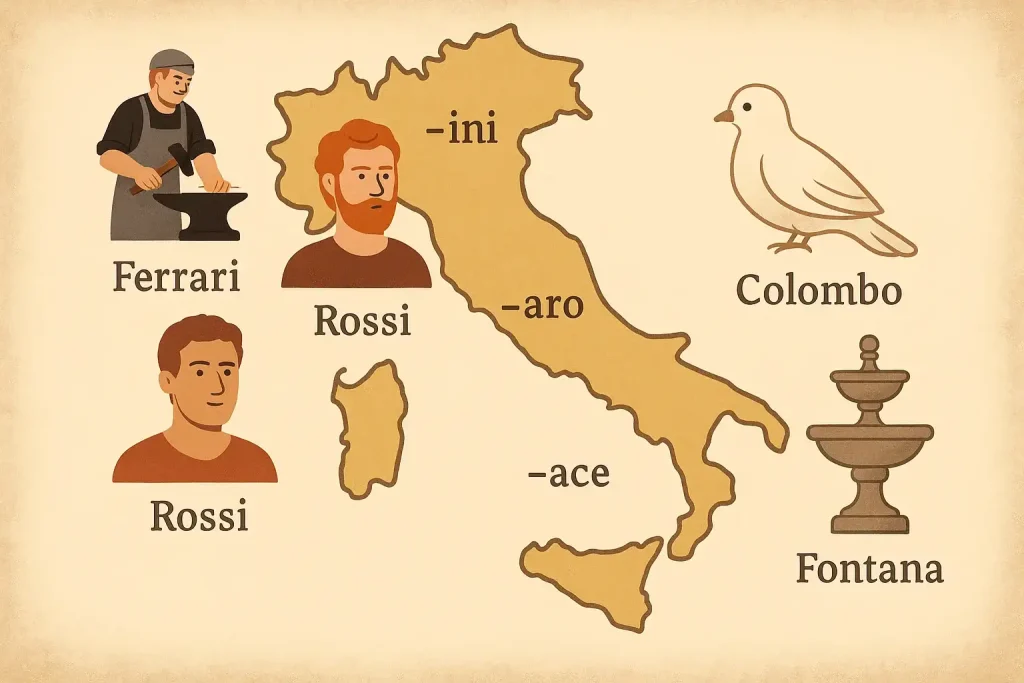
Here are the five layers most Italian surnames fall into:
1. Patronymic (From a Parent’s Name)
These are based on a parent’s first name, usually the father’s. Think Di Stefano (“son of Stefano”) or De Luca (“from Luca”). Like carrying a family echo down the line.
2. Locative or Geographic (From a Place)
Names tied to geography: Romano (“from Rome”), Napolitano (“from Naples”), Fontana (“near a fountain”). They’re like addresses carved into your name.
3. Occupational (From a Job or Trade)
Think Ferrari (blacksmith), Speziale (apothecary), or Barbieri (barber). These names tell you what the ancestors did, not just who they were.
4. Descriptive or Nickname-Based
Often playful or blunt. Rossi (red-haired), Grasso (fat), Basso (short), Ricci (curly). These names likely began as bar talk and stuck for generations.
5. Foundling Names (Orphan Origins)
Names [like Esposito (“exposed”), Colombo (“dove”), Innocenti (“innocents”)] were given to abandoned children in orphanages, especially in Naples and Florence.
As one user on Quora said, “Your surname in Italy is your street, your story, your skin. It follows you even when your first name doesn’t.”
31 Great Italian Last Names & Their Rich Meanings
Here’s a handpicked mix of 31 great Italian last names, both familiar and forgotten.
| Surname | Meaning & Story |
| Rossi | “Red-haired.” The most common surname in Italy. Often linked to Tuscany. Symbol of strength. |
| Esposito | “Exposed.” Given to abandoned children. Especially common in Naples. A name born from sorrow, reclaimed with pride. |
| Ferrari | “Blacksmith.” A working-class badge of honor. Sturdy, practical, iconic—much like the car that carries the name. |
| Vitale | “Life-giving.” Common in the south. A name that feels like a prayer. |
| Romano | “From Rome.” A surname steeped in legacy, history, and timeless pride. |
| Amato | “Beloved.” Found in Campania and Sicily. Romantic, melodic, and rare. |
| Conti | “Count.” A title, once. Now, a name still echoing noble roots. |
| Ventura | “Fate” or “luck.” The kind of name that sounds like a novel waiting to be written. |
| Fontana | “Fountain.” From homes near springs. Symbolizes purity and source. |
| Barbieri | “Barber.” One of Italy’s oldest occupational names. Popular in Lombardy. |
| Giordano | “Of the Jordan.” Biblical, symbolic, poetic. Popular from Lazio to Calabria. |
| Napolitano | “From Naples.” Loud, proud, and full of southern soul. |
| Ricci | “Curly.” Often from affectionate nicknames. A surname with bounce and personality. |
| Lombardi | “From Lombardy.” Tied to the north. Industrial, polished, strong. |
| D’Amico | “Of the friend.” Kindness baked into the name. Common in Sicily. |
| Bellini | “Little beautiful one.” Artistic and sweet. Linked to the famous opera composer. |
| De Luca | “Son of Luca.” Classic patronymic. Popular across the peninsula. |
| Leone | “Lion.” Heraldic and bold. A name that carries courage in every letter. |
| Bianchi | “White.” Likely descriptive of hair or skin tone. Widespread in the north. |
| Grasso | “Fat.” Once teasing, now historical. Found in Sicily and Calabria. |
| Speziale | “Apothecary.” Rare. Carries a scent of herbs, tradition, and quiet knowledge. |
| Caruso | “Young man.” Immortalized by tenor Enrico Caruso. Noble in voice, humble in root. |
| Versace | Rare surname from Reggio Calabria. Elevated to fame by fashion. Means “to turn” or “to change.” |
| Testa | “Head.” Could mean intelligence, stubbornness, or baldness. You decide. |
| Moretti | “Little dark one.” Common surname with a dusky mystique. |
| Greco | “Greek.” Reflects southern Italy’s Hellenic ties. Especially in Calabria. |
| Gallo | “Rooster.” Prideful, energetic, full of flair. |
| Pagano | “Pagan.” A leftover from religious transitions. Once frowned on, now poetically intriguing. |
| Rinaldi | From “Reinald.” Germanic roots; spread across Emilia-Romagna and Lazio. |
| Palmieri | “Palm-bearer.” Often tied to religious ceremonies. Seen in Tuscany. |
| Sanna | Common in Sardinia. No agreed meaning—some say “old,” others say “healthy.” Wrapped in mystery. |
| Bocelli | “Little mouth.” Rare, but made eternal by Andrea Bocelli’s voice. |
Most Popular Italian Last Names in Italy (Top 20 Stats of 2025)
Italy counts nearly 369,000 unique surnames, but a small group dominates. According to the 2025 Forebears data, here are the top 20 surnames by incidence:
| Rank | Surname | Count | Approx. Frequency (Italy-wide) |
| 1 | Rossi | 347,288 | 1 in 176 people |
| 2 | Russo | 220,472 | 1 in 277 |
| 3 | Ferrari | 196,529 | 1 in 311 |
| 4 | Esposito | 155,359 | 1 in 394 |
| 5 | Colombo | 133,381 | 1 in 459 |
| … | … | … | … |
| 20 | Lombardi | 71,073 | 1 in 860 |
(Full list referenced from Forebears) Forebears+2Forebears+2Forebears+2Wikipedia
Rich & Wealthy Italian Last Names: 17 Nobility-Inspired Surnames
Historically, noble families often bore surnames with “De,” “Della,” or compound structures. Others were landowners, merchants turned financiers, or Popes in disguise. Today, their descendants might run empires of chocolate, optics, or fashion.
17 Wealthy or Aristocratic Italian Surnames
| Surname | Background |
| Medici | Banking dynasty of Florence. Produced Popes and funded the Renaissance. |
| Chigi | Roman nobility. Linked to the Vatican, cardinals, and architecture. |
| Sforza | Milanese rulers. Military power meets political finesse. |
| Borgia | Spanish-Italian family. Infamous and influential in Vatican politics. |
| Barberini | Prominent papal family. “What the barbarians didn’t do, the Barberini did.” |
| Doria | Genoese admirals and statesmen. One of the oldest noble houses. |
| Farnese | Dukes of Parma, patrons of art and architecture. |
| Gonzaga | Rulers of Mantua. Known for art patronage and military prowess. |
| Savoy (Savoia) | Former royal family of Italy. United the nation under monarchy. |
| Tornabuoni | Florentine merchants and patrons. Associated with Medici and Botticelli. |
| Giustiniani | Venetian nobles. Linked to maritime trade and governance. |
| Del Vecchio | Founder of Luxottica (Ray-Ban, Oakley). Net worth ~$25B (Forbes) |
| Ferrero | Makers of Nutella, Ferrero Rocher. Family wealth surpasses $30B (Forbes) |
| Armani | Fashion legend. Giorgio Armani is globally renowned for elegance. |
| Berlusconi | Businessman and ex-Prime Minister. Built Mediaset and political power. |
| Benetton | Fashion empire known for bold marketing. Based in Treviso. |
| Versace | Luxury fashion house. Name now symbolic of global Italian style. |
Last Names of Italian Violin Makers: 11 Names that Changed Music Forever
Long before “Made in Italy” meant leather bags or designer suits, it meant sound. Italian violin makers didn’t just build instruments. They shaped the voice of classical music.
The epicenter? Cremona, a northern town where three surnames became immortal: Stradivari, Amati, and Guarneri. These names are whispered in concert halls, auction houses, and conservatories. Each violin they crafted was as unique as a fingerprint, but all unmistakably Italian.
11 Legendary Italian Violin Maker Surnames
| Surname | Legacy & Region |
| Stradivari | Antonio Stradivari (1644–1737). His violins are worth millions. Cremona’s crown jewel. |
| Amati | Andrea Amati founded the Cremonese school. Grandfather of the modern violin. |
| Guarneri | Del Gesù Guarneri violins rival Strads in power and warmth. Favored by Paganini. |
| Bergonzi | Carlo Bergonzi trained under Stradivari. Known for refined sound and rare varnish. |
| Gagliano | Naples-based dynasty of luthiers. Mixed southern boldness with northern finesse. |
| Grancino | Milanese makers. Pre-Stradivari influence; warm, clear tones. |
| Maggin | Brescia origin. Older than Amati, but rawer in style. |
| Ceruti | Cremonese revivalist in the 18th century. Carried the tradition past Stradivari’s death. |
| Rocca | Turin family of the 1800s. Copied Stradivari closely with personal flair. |
| Pressenda | Piedmont-based. Known for structure and volume—suitable for larger concert halls. |
| Villa | Modern Cremonese maker. Revered by current soloists for rich, dynamic sound. |
Rare & Fancy Italian Last Names That Sound Like Royalty (22 Picks)
Some Italian surnames weren’t made for crowds. Instead, they were carved for characters, aristocrats, and signatures on gilded parchment.
22 Rare and Fancy Italian Surnames with Style
| Surname | Meaning & Feel |
| Della Rovere | “Of the oak tree.” Noble house from Urbino. Refined and timeless. |
| Del Monte | “Of the mountain.” Regal and geographical. Sounds both grounded and elevated. |
| De Angelis | “Of the angels.” Light, celestial, and romantic. |
| Bellavita | “Beautiful life.” Feels like a wine label or perfume line. |
| Gentilini | “Little kind ones.” Soft, melodic, and old-world. |
| Farnese | Dukes of Parma. A real aristocratic name, steeped in art patronage. |
| Altamura | From the town in Puglia. Rolls off the tongue like music. |
| La Serenissima | Nickname for Venice; rarely a surname, but poetic in compound use. |
| Valentini | From “valente,” meaning brave or strong. Classic with flair. |
| Rossellini | Made famous by filmmaker Roberto Rossellini. Cinematic and smooth. |
| Palombella | “Little dove.” Gentle and elegant—perfect for delicate characters. |
| Baronchelli | Derived from “barone” (baron). Rare and aristocratic. |
| Lucchesi | “From Lucca.” Noble Tuscan heritage, sounds like lace and lanterns. |
| Cavalcanti | Medieval poet family. Evokes armor and romance. |
| Montanari | “People of the mountains.” Evokes solitude and strength. |
| Volpe | “Fox.” Clever, sleek, and sly—great for characters with intrigue. |
| Montalbano | “White mountain.” Made popular by the detective series. Literary and solid. |
| Valmarana | Venetian noble family. Soft syllables, strong history. |
| Borghese | Papal nobility. One of Rome’s most opulent families. |
| Morellini | “Little dark one.” Mysterious and lyrical. |
| D’Orazio | “Of Horace.” Classical, intellectual, and rare. |
| Albertoni | Minor Roman noble line. Polished and versatile. |
18 Mobster-Sounding Italian Last Names (And Their Dark Backstories)
Some surnames sound dangerous. They roll off the tongue like secrets. Following are the mobster-sounding Italian last names. They’re stitched into headlines, court records, and cinematic legend.
18 Italian Last Names With Mobster Weight
| Surname | Story & Legacy |
| Genovese | Vito Genovese led one of NYC’s most powerful crime families. Cemented in mafia lore. |
| Bonanno | Joseph Bonanno helped shape the American Mafia structure. Fiction and fact blend here. |
| Lucchese | Thomas Lucchese turned a Bronx crew into a national empire. Name still feared. |
| Gambino | Carlo Gambino, known as “The Godfather,” ruled in quiet power. The surname became a myth. |
| Colombo | Joseph Colombo ran the family that bears his name. Also led Italian-American civil rights efforts. |
| Corleone | Fictional but iconic. Taken from a real Sicilian town, made legendary by The Godfather. |
| Ruggiero | “Lefty” Ruggiero’s betrayal and downfall inspired Donnie Brasco. |
| Giancana | Sam Giancana, Chicago Outfit boss. Tied to JFK, Cuba, and conspiracy. |
| Profaci | Precursor to the Colombo family. Old-school mafioso known for Sicilian discipline. |
| DeCavalcante | New Jersey family that inspired The Sopranos. Real name, real crimes. |
| Massino | Joseph Massino turned state’s witness. The first boss to flip. |
| Maranzano | “Boss of bosses” before being assassinated in 1931. Invented Mafia structure. |
| Carbone | Used in Goodfellas. Means “coal”—gritty, dark, elemental. |
| Trapani | Real Sicilian surname. Often fictionalized due to its harsh phonetics. |
| Bruno | Angelo Bruno, Philadelphia boss, known as “The Gentle Don.” Killed in a car bomb. |
| Accardo | “Joe Batters” Accardo ruled Chicago after Capone. Ruthless and quiet. |
| Benedetto | Common surname, often given to fictional dons. Means “blessed”—delicious irony. |
| Saviano | Writer of Gomorrah. The name now symbolizes truth against organized crime. |
Tips for Naming Characters in Italian Last Names
How to Craft Realistic Italian Last Names
- Match region to suffix:
- Northern names: end in -i (Bianchi, Moretti)
- Southern names: end in -o (Russo, Amato)
- Sicilian or Calabrian: may end in -aro, -ace, or -isi (Cavallaro, Versace)
- Sardinian: end in -u, -as, -is (Sanna, Piras)
- Northern names: end in -i (Bianchi, Moretti)
- Use patronymic prefixes:
- Di, De, D’ → “son of” or “from”
- Examples: De Luca, D’Amico, Di Stefano
- Di, De, D’ → “son of” or “from”
- Choose by character’s class or setting:
- Noble/aristocratic: Della Rovere, Farnese, Gentilini
- Working class or old trade: Ferrari, Speziale, Barbieri
- Mysterious: Morellini, Palombella, Lucchesi
- Noble/aristocratic: Della Rovere, Farnese, Gentilini
Writer Tips: Naming With Intention
- Think of names as audible mood boards. Rinaldi feels more commanding than Bellini—so use them accordingly.
- Avoid clichés like Corleone unless intentional parody or homage.
- Research regional dialect if your story is location-specific.
- Use rare but real names to avoid generic characters.
Italian Last Names by Letter (A–Z Breakdown with Regional Flavor)
Italian surnames are alphabet soup with soul. Each letter tells a story, and many echo regional dialects, noble houses, or old professions. Here’s a curated A–Z peek into Italy’s surname vault.
12 Italian Last Names Starting with A (Amato, Abate, etc.)
| Surname | Meaning & Notes |
| Amato | “Beloved.” Common in Sicily and southern Italy. |
| Abate | “Abbot” or cleric. Often found in Calabria. |
| Alfieri | “Standard-bearer.” Noble, poetic, and military-rooted. |
| Altieri | Roman noble family. Linked to papal history. |
| Antonelli | Patronymic of Antonio. Soft, melodic name. |
| Agnelli | Fiat founder’s name. Industrial legacy from Piedmont. |
| Ambrosini | “Immortal.” From Greek origin, found in Lombardy. |
| Anselmi | Medieval roots, meaning “God’s helmet.” Common in Emilia-Romagna. |
| Accardo | Southern Italian; tied to noble families and mafia lore. |
| Albano | From Latin “Albanus,” meaning white or noble. |
| Arcuri | Found in Calabria and Sicily. Possibly from Arabic influence. |
| Aversa | Geographic name from the town in Campania. |
9 Italian Last Names Beginning with B (Bianchi, Bruni, etc.)
| Surname | Meaning & Notes |
| Bianchi | “White-haired” or “fair.” Northern Italy’s answer to Smith. |
| Bruni | “Brown-haired.” Simple, sturdy, widespread. |
| Bellini | “Little beautiful one.” Artistic, emotional, lyrical. |
| Barbieri | “Barber.” Classic trade name. Strong in Emilia-Romagna. |
| Benetti | Diminutive of Benedetto. Common in Veneto. |
| Barone | “Baron.” Tied to nobility or arrogance, depending on the source. |
| Baldi | “Bold.” Found across Tuscany and Lazio. |
| Bocelli | “Little mouth.” Rare but famous thanks to Andrea Bocelli. |
| Bellucci | “Pretty” or “handsome.” Tied to central Italy. |
10 Italian Last Names Beginning with G (Giordano, Greco…)
| Surname | Meaning & Notes |
| Giordano | “Of the Jordan.” Spiritual and biblical roots. |
| Greco | “Greek.” Reflects Magna Graecia heritage in southern Italy. |
| Grasso | “Fat.” Once blunt, now just descriptive. |
| Gallo | “Rooster.” Bold, symbolic, Sicilian flair. |
| Gentile | “Kind.” Gentle and poetic. Common across the peninsula. |
| Guarino | From “warden.” Archaic, but still found. |
| Gatti | “Cats.” Often tied to personality. Widespread in Lombardy. |
| Giacomelli | Patronymic of Giacomo. Elongated and elegant. |
| Gualtieri | From “Walter.” Norman influence, especially in central Italy. |
| Giorgini | “Little George.” Tuscan origin. |
11 Italian Last Names Starting with L (Lombardi, Leone…)
| Surname | Meaning & Notes |
| Lombardi | “From Lombardy.” Indicates northern heritage. |
| Leone | “Lion.” Bold, fearless, often linked to coats of arms. |
| Luciani | From “Lucianus.” Common in Rome and Umbria. |
| Landi | “Of the land.” Old farming family roots. |
| Lisi | Possibly from Elisabetta. Apulia and Basilicata. |
| Latini | “Latin people.” Noble and historical in sound. |
| Laurenti | From “laurel.” Classical flair, ancient Rome vibes. |
| Licata | Town in Sicily. Indicates geographic descent. |
| Loffredo | Rare, noble-sounding. Central/southern Italy. |
| Longo | “Tall.” Physical description turned surname. |
| Luzzi | Found in Calabria. Possibly from town name. |
14 Italian Last Names Starting with V (Vitale, Valentini…)
| Surname | Meaning & Notes |
| Vitale | “Vital.” Uplifting, popular in southern Italy. |
| Valentini | “Brave.” Plural/patronymic of Valentino. |
| Villa | “Estate” or “village.” Common in Lombardy. |
| Volpe | “Fox.” Clever, mysterious. |
| Venezia | From Venice. Elegant and regional. |
| Vinci | From town of Vinci—home of da Vinci. |
| Vannini | From Giovanni. Tuscan/central roots. |
| Vassallo | “Vassal” or servant. Feudal roots. |
| Valerio | “Strong.” Classical-sounding and noble. |
| Valente | “Worthy” or “strong.” Found in Naples and Lazio. |
| Ventura | “Luck” or “fate.” Romantic and hopeful. |
| Vercelli | From the city in Piedmont. Rare outside the region. |
| Viola | “Violet” or instrument. Poetic and musical. |
| Villani | “Villager.” Topographic surname. |
8 Italian Last Names Beginning with P (Pellegrini, Palumbo…)
| Surname | Meaning & Notes |
| Pellegrini | “Pilgrim.” Spiritual and humble. |
| Palumbo | “Pigeon.” Southern Italy. Represents peace or travel. |
| Pugliese | “From Puglia.” Geographic, proud. |
| Parisi | “Parisian.” French-Italian connection. |
| Pastore | “Shepherd.” Classic biblical occupation. |
| Piazza | “Town square.” Symbol of connection. |
| Piccirillo | “Little one.” Often a childhood nickname. |
| Pasquale | From Easter. Often tied to birthdays or baptism dates. |
7 Italian Last Names Starting with F (Ferrari, Fontana…)
| Surname | Meaning & Notes |
| Ferrari | “Blacksmith.” One of Italy’s most common and powerful surnames. |
| Fontana | “Fountain.” From homes near springs. Pure and geographic. |
| Fabbri | “Smiths.” Common artisan name in Emilia-Romagna. |
| Fiorentino | “From Florence.” High-culture vibe. |
| Fazio | Greek-Latin origin, often Sicilian. Rare but refined. |
| Falco | “Falcon.” Noble and aggressive. |
| Franchi | “Frankish.” Name of foreign invaders turned family line. |
13 Italian Last Names Starting with R (Rossi, Romano…)
| Surname | Meaning & Notes |
| Rossi | “Red-haired.” Most common surname in Italy. |
| Romano | “From Rome.” Timeless and classic. |
| Ricci | “Curly-haired.” Descriptive and common. |
| Rinaldi | From German “Reinald.” Strong and knightly. |
| Russo | “Red.” Southern variant of Rossi. |
| Ruggiero | Warrior name. Common in Naples. |
| Rossetti | Diminutive of Rossi. Poetic and refined. |
| Riva | “Shore” or “bank.” Geographic. |
| Renzi | Tuscany-origin. Made famous by Italian PM. |
| Romagnoli | “From Romagna.” Regional pride. |
| Rossiello | Rare variation of Rossi. |
| Ruggieri | Another form of Ruggiero. |
| Rossioli | Ultra-rare. Compound of Rossi. |
6 Italian Last Names Starting with T (Tedesco, Testa…)
| Surname | Meaning & Notes |
| Tedesco | “German.” Often given to immigrants or outsiders. |
| Testa | “Head.” Possibly bald, smart, or stubborn. |
| Toscano | “From Tuscany.” Regional, proud, warm. |
| Troiano | “Trojan.” Historic and mythic flair. |
| Tiberi | From “Tiberius.” Ancient Roman power. |
| Tagliani | “Tailor.” Occupational surname, still in use today. |
Southern Italian Last Names: 15 Beautiful Surnames From the South
Southern Italian last names across Campania, Sicily, and Calabria, regions where cultures collided.
Southern surnames often end in -o, and many reflect Greek, Arabic, or Spanish influence. That’s the legacy of a land once ruled by Byzantines, Moors, Normans, and Spanish kings.
15 Distinctive Southern Italian Last Names
| Surname | Origin & Meaning |
| Esposito | “Exposed.” Given to foundlings in Naples. Heartbreaking origin, now worn with pride. |
| Amato | “Beloved.” A common surname in Calabria and Sicily. Soft and sentimental. |
| Pugliese | “From Puglia.” A name tied to olive groves and sun-drenched hills. |
| Greco | “Greek.” Common in Calabria, reflecting ancient Hellenic roots. |
| D’Amico | “Of the friend.” Gentle, approachable, familial. |
| Palumbo | “Pigeon.” Symbol of peace and Southern identity, especially in Campania. |
| Mancuso | Possibly from Greek “manikos” (mad or spirited). Distinct Calabrian flair. |
| Gulotta | Arabic influence. Found in western Sicily. May reference coastal geography. |
| Trovato | “Found.” Another name for orphans, similar to Esposito. Common in Sicily. |
| Lo Monaco | “The monk.” Found across Sicily, often noble or religious in origin. |
| Sammarco | “Saint Mark.” A religious toponym common in southern parishes. |
| Coppola | May derive from the traditional flat cap, or from cupola (dome). Neapolitan icon. |
| Alfano | From Arabic “al-fan.” Elegant, rare, Sicilian. |
| Licata | From the town of Licata in Agrigento. Bold and geographic. |
| Fazio | Rooted in southern dialects. Possibly from Latin “Facius”—a Roman family name. |
Are There Female Italian Last Names? (And Why It’s a Trick Question)
Here’s the truth: Italian last names don’t change based on gender. Whether you’re a man or a woman, your surname stays exactly the same. No “-a” for women, no gender flip. In Italy, your last name is a fixed family identity, not a personal trait. If your brother is Marco Bianchi, you’re Giulia Bianchi. No changes. This structure goes back centuries and is legally reinforced: women don’t take their husband’s surname in Italy either.
What About Suffixes Like -ina, -etta, or -ella?
While Italian first names often play with gendered endings (Francesca, Mariella, Antonietta), surnames might occasionally look feminine, but they aren’t gendered by function. For example:
- Bellini = “little beautiful one” → not gender-specific
- Morelli = “little dark one” → purely descriptive
- Rossella (first name) vs Rosselli (surname) → different categories entirely
Some rare dialectal variants (especially in Sardinia or southern villages) might lean toward softer-sounding surnames. But this is regional music, not rule-breaking.
Wrap-Up: What Makes an Italian Last Name Truly Special?
An Italian last name is on the trail of your past. It might tell you your ancestor was a blacksmith (Ferrari), or came from Naples (Napolitano). It can sometimes tell your grandfather was once left at the gates of an orphanage (Esposito). Some names are noble. Others are humble. All of them carry something real.What makes them truly special is this: they last. Long after voices fade, they stay on documents, doorbells, and gravestones.